

Category: Pest Identification / Home Safety
Reading Time: 8 Minutes
If you are reading this, you are probably feeling a mix of anxiety and confusion. You found a tiny, brownish bug in your bedroom. A bed bug??? Maybe it was on the sheets, maybe it was crawling up the baseboard near your nightstand.
Your immediate thought? “Bed bugs.”
Panic is a natural reaction. Bed bugs are a major issue in Toronto, from high-rise condos in Liberty Village to detached homes in North York. However, in our experience at City & Country Pest Control, nearly 50% of the “bed bug” calls we receive turn out to be Carpet Beetles.
While both are nuisance pests, the difference between them is massive. One requires a simple deep clean; the other requires a professional strategic war.
This guide will help you identify which intruder you have in less than 5 minutes, explained simply, without the scientific jargon.
The Quick Bed Bug Identification
If you are in a rush, look at the bug and compare it to this chart. This is the fastest way to know what you are dealing with.
| Feature | The Bed Bug | The Carpet Beetle |
| Shape | Flat and Oval (Like an apple seed) | Round and Domed (Like a tiny ladybug) |
| Color | Reddish-Brown / Rusty | Mottled Brown, Black, White, or Orange (Camo print) |
| Wings? | No. Bed bugs never fly. | Yes. They have a hard shell and can fly. |
| Legs | 6 visible legs | 6 legs, but they often tuck them underneath |
| Speed | Fast scurry (crawling) | Slow crawl, or flight |
| Diet | Blood (You) | Natural Fibres (Wool, Fur, Dust, Hair) |
The “Apple Seed” vs. “The Ladybug”
The easiest mental shortcut is this:
-
Bed Bugs look like a flat apple seed. If you squish it (please don’t, but if you did), it pops.
-
Carpet Beetles look like miniature, camouflage-coloured ladybugs. They have a hard, crunchy shell on their back.
Part 1: Anatomy of the Enemy
To defeat the pest, you must understand what you are looking at. Let’s break down the physical appearance of both bugs so you can be 100% sure.
The Bed Bug (Cimex lectularius)
Bed bugs are masters of hiding, but when they are out in the open, they are distinct.
1. The Shape: They are incredibly flat. Think of a piece of paper or a credit card. This flatness allows them to slide into the tiniest cracks in your headboard or floorboards. They are not “puffy” unless they have just fed.
2. The Texture: If you look closely (or use your phone’s zoom), the back of a bed bug has ridges, almost like the texture of a Ruffles potato chip.
3. The Life Cycle: You might not see an adult. You might see a “Larva” (baby). These look like translucent, smaller versions of the adult.
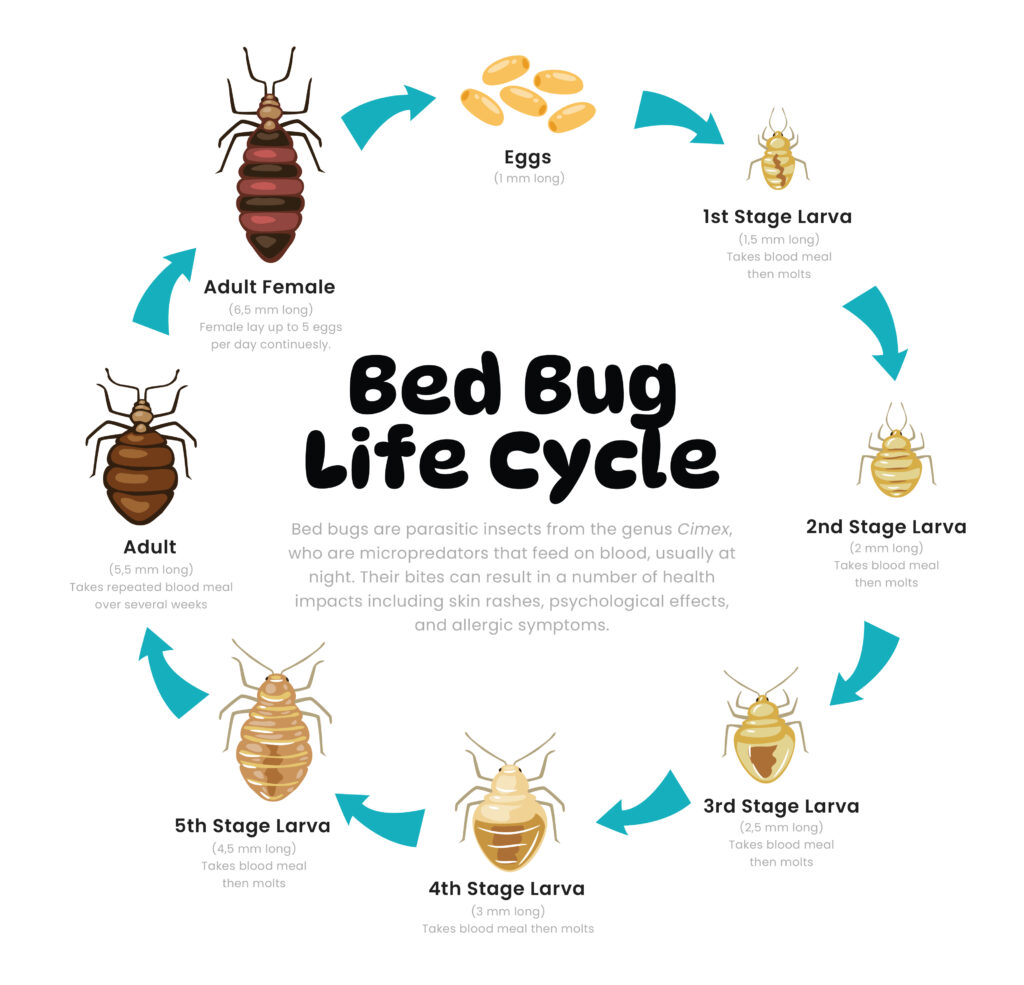
As seen in the diagram above, the bed bug grows through stages. Note that even at the “1st Stage Larva,” the shape remains consistent—oval and leggy.
The Carpet Beetle (Anthrenus verbasci)
These are often smaller than bed bugs, often about the size of a pinhead (1-4mm).
1. The Shell: Unlike the bed bug, the carpet beetle has a hard casing called a carapace (like a beetle or ladybug). A bed bug is soft; a carpet beetle is armoured.
2. The Pattern: Most carpet beetles in Ontario are “Varied Carpet Beetles.” Their backs look like they are wearing military camouflage—patches of white, brown, and yellow scales. If the bug is solid black, it might be a “Black Carpet Beetle,” which is also common in Toronto.
3. The Wings: If the bug you found flies towards the window, stop worrying about bed bugs immediately. Bed bugs cannot fly. Carpet beetles can and do fly, often towards natural light.
Part 2: The “Bite” Test (and Why It’s Tricky)
“I woke up with red marks. It must be bed bugs, right?”
Not necessarily. This is the most common misconception we see. Here is the science behind the “bite.”
The Bed Bug Bite
Bed bugs are parasites. They feed on human blood. When they bite, they insert a tiny amount of anesthetic (so you don’t feel it) and an anticoagulant (so the blood flows).
-
The Pattern: Bed bugs are nervous eaters. If you move while sleeping, they stop, move an inch, and bite again. This often results in a line of 3 or 4 bites, frequently jokingly called “Breakfast, Lunch, and Dinner.”
-
The Location: They usually bite exposed skin while you sleep—arms, neck, and shoulders.
The Carpet Beetle “Bite” (Dermatitis)
Carpet beetles do not bite humans. They do not have the mouthparts for it. They eat wool and dust.
However, their larvae (the babies) are covered in tiny, bristly hairs. When these larvae crawl across your skin while you sleep, or if you touch a towel they have been on, those hairs can puncture your skin or cause an allergic reaction.
This is called Carpet Beetle Dermatitis. It looks like a red, itchy, bumpy rash that almost matches a bed bug bite.
The Bottom Line: Do not diagnose the bug based solely on the bite. You need to find the physical evidence of the insect.
Part 3: The Bed Bug Investigation – Where to Look
If you haven’t found the bug yet but suspect you do, you need to perform an inspection. Grab a flashlight and a credit card (to swipe through cracks).
If it’s Bed Bugs…
You are looking for the “Halo” around where you sleep. Bed bugs rarely travel far from their food source (you).
- The Mattress Seams: Pull back your sheets. Look at the piping (the thick edge) of your mattress. Use the credit card to flip the seam up. You are looking for black ink-dot stains (fecal matter) or the bugs themselves.
- The Headboard: This is their favourite VIP lounge. If your headboard is bolted to the wall, they are likely behind it.
- The Box Spring: Check the plastic corner guards and the staple holes on the underside of the dust cover.
If it’s Carpet Beetles…
You are looking for “Quiet Dark Corners” where dust collects.
- Baseboards and Edges: Carpet beetle larvae move along the edges of the room where the vacuum cleaner often misses.
- Closets: Check the floor, especially if you have wool sweaters, leather bags, or silk stored there.
- Under the Bed: Not on the bed, but under it. If you have dust bunnies under the bed, carpet beetle larvae are likely feeding on the hair and skin cells inside that dust.
- Windowsills: Adult beetles want to get outside to find pollen. You will often find dead adults lying on your window sills.
Part 4: Why are Bed Bugs happening in my Toronto home?
It helps to understand how they got in.
Bed Bugs are Hitchhikers.
They don’t come in from the garden. They are brought in.
-
Public Transit: Taxis, Ubers, and even the TTC (fabric seats) can harbour them.
-
Travel: Did you stay in a hotel recently? Or have a guest who did?
-
Neighbours: In Toronto, condos and row houses, bed bugs can travel through electrical outlets and baseboards from the unit next door.
Carpet Beetles are Nature.
They live outside, feeding on pollen. They fly into your home through open windows, or they hitch a ride on fresh-cut flowers. Once inside, they lay eggs in dark, lint-filled areas. They are a sign of nature getting in, not necessarily a “dirty” home—though regular vacuuming discourages them.
Part 5: The Bed Bug Larvae Danger (The “Woolly Bear”)
We mentioned earlier that adult Carpet Beetles are harmless. The danger comes from their children.
If you find a tiny, hairy worm that looks like a miniature fuzzy caterpillar (often brown and striped), that is a Carpet Beetle Larva.
These larvae have a voracious appetite for “keratin”—the protein found in animal fibres. They will eat:
-
Your expensive wool rugs.
-
Cashmere sweaters.
-
Silk blouses.
-
Feathers (down pillows).
-
Pet hair that accumulates in corners.
If you see holes in your sweaters that look like a hole-puncher made them, you have Carpet Beetle larvae, not moths.
Part 6: How to Fix It (The Solution)
Now that you have identified the enemy, here is your battle plan.
Scenario A: It is a Carpet Beetle
Severity: Low to Medium
You can often handle a minor infestation yourself.
- The Purge: Locate the source. Usually, it is an old wool item or a heavy accumulation of pet hair. Bag it and remove it.
- The Deep Clean: You need to vacuum as you’ve never vacuumed before. Use the wand attachment to reach every crevice in the baseboards and under heavy furniture. You are trying to suck up the eggs and larvae.
- Heat: Wash bedding and clothes in hot water and dry on high heat.
- Monitor: If the problem persists after a deep clean, professional residual sprays can be applied to baseboards to break the breeding cycle.
Scenario B: It is a Bed Bug
Severity: High (Emergency)
Do not attempt DIY.
We cannot stress this enough: Store-bought “Bed Bug Foggers” or “Bombs” usually make the problem worse.
When you set off a fogger, the chemical does not penetrate the deep cracks where bed bugs hide. Instead, it irritates them. They sense the chemical and scatter, moving deeper into the walls or spreading to other rooms in your house. You turn a one-room problem into a whole-house disaster.
Professional Treatment is Required.
At City & Country, we use Integrated Pest Management (IPM) for bed bugs. This may involve:
-
Chemical Treatments: Using professional-grade products that have a “transfer effect” (bugs walk through it and carry it back to the nest).
-
Heat Treatments: Raising the ambient temperature of your home to a level that dehydrates and kills all life stages (eggs, nymphs, and adults) in one go.
The Bed Bug Bottom Line
If you found a bug and you are still staring at it, unsure of what it is, don’t guess.
Take a picture.
Zoom in as close as you can. Please email it to us at City & Country Pest Control with your Name and Phone Number. We can often identify the pest over the phone or email.
-
If it’s a Carpet Beetle, we’ll tell you to grab your vacuum.
-
If it’s a Bed Bug, we’ll call you to get a technician to your door ASAP to stop the infestation before it grows.
Your home should be your sanctuary, not a source of stress. Whether it’s a false alarm or the real deal, we are here to help Toronto sleep tight.