
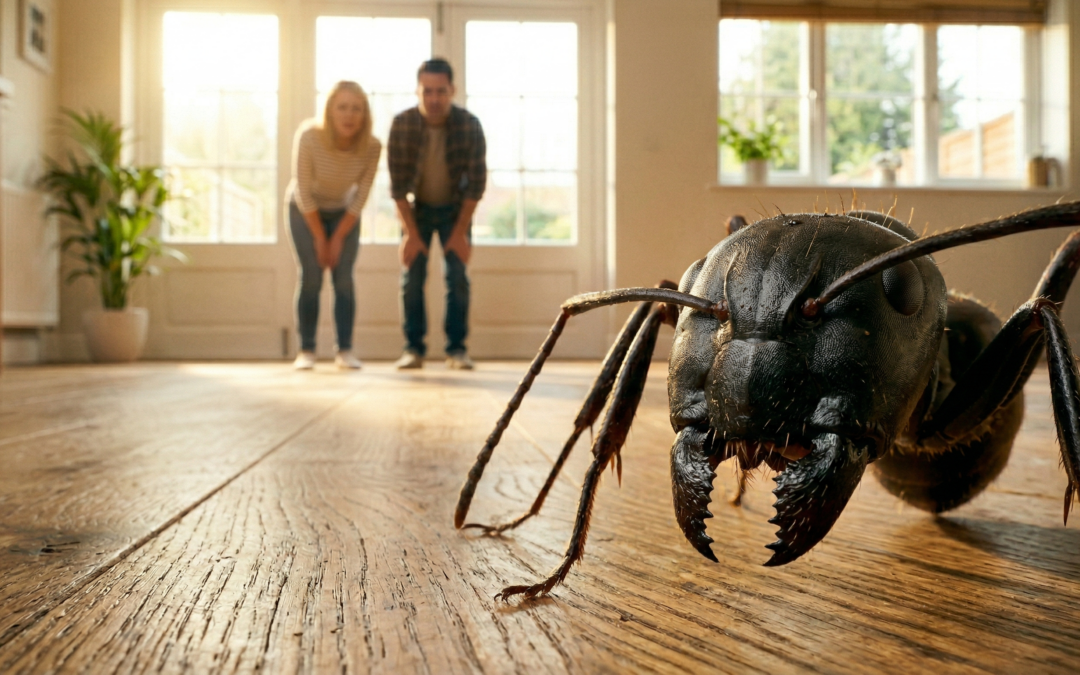
It is late March in Ontario. The snow is melting, the ground is still half-frozen, and you are sitting in your kitchen enjoying your morning coffee. Suddenly, you see it: sluggish black ants wandering across the floor.
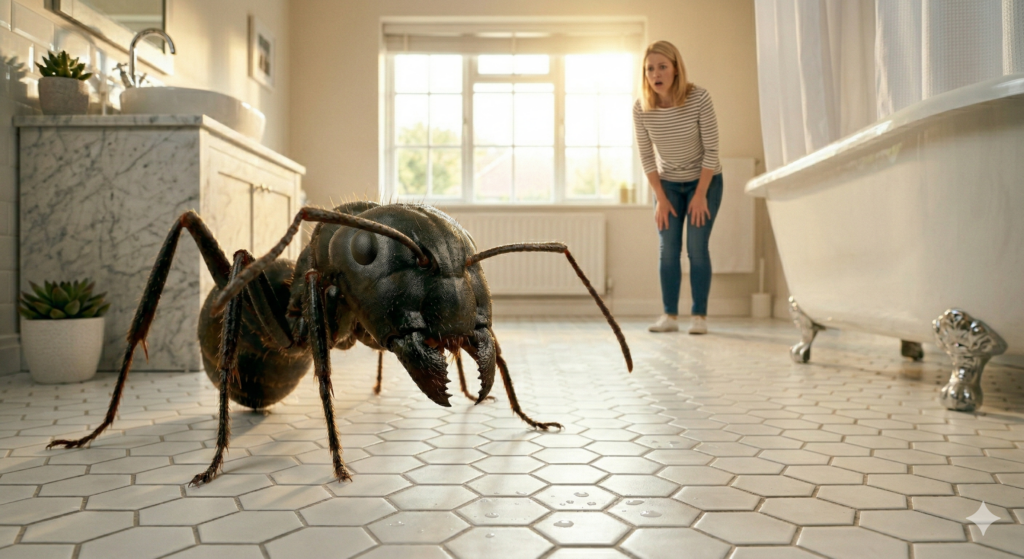
Then you see more black ants in the bathroom.
Your first thought is likely confusion. “It’s barely above freezing outside. Where did they come from? Did they just walk in the front door?”
At City & Country Pest Control, this is the number one question we get every spring. We are going to give you the honest, straightforward answer right now: These black ants did not come from outside. If you are seeing large black ants inside your home in March or early April, they have been living inside your walls all winter.
Here is exactly what is happening, how to tell if you are dealing with a structural threat, and how to stop them before they multiply.
Why are there large black ants in my house in early spring?
If you see Carpenter Ants inside your Ontario home during March or April, it means you have a “satellite nest” located somewhere inside your house. Because the weather outside is still too cold for insects to survive, these ants did not come from the outdoors. The early spring sun has warmed the exterior walls of your home, acting like an oven. This heat tricks the hibernating ants inside your walls into thinking it is summer. They wake up early and wander into your living space looking for food.
The Bottom Line: Finding large ants indoors before the snow has completely melted is the clearest indicator of an internal infestation rather than an external invasion.
Part 1: The “Solar Oven” Effect (Why Black Ants Wake Up Early)
To understand how to defeat Carpenter Ants, you have to understand how they experience the world. They are entirely dependent on temperature.
During a harsh Canadian winter, a colony of carpenter ants living in a tree stump outside goes completely dormant. They essentially freeze solid.
But a colony living inside the wall of a heated Toronto home has a different experience.
Think of your house like a giant thermos. You pay good money to pump heat into it all winter. While the insulation keeps most of the heat in, some of it bleeds into the wall voids. When the late-March sun hits the dark brick or siding on the south-facing side of your home, the temperature inside that specific wall void spikes.
-
The Illusion: The ants inside the wall feel a sudden warmth (often reaching 20°C, even if it is 5°C outside).
-
The Awakening: Their biology tells them, “Spring is here! Time to go to work!”
-
The Trap: They wake up, stretch their legs, and walk out from behind your baseboards. But when they try to go outside to forage, it’s too cold. So, they turn around and head straight for your kitchen and bathrooms.
Part 2: Identifying the Enemy (Are These Black Ants Really Carpenter Ants?)
Not every ant is a Carpenter Ant, but if it is early spring and the ant is huge, the odds are not in your favour.
Here is how to identify them without needing a microscope:
1. The Size Test Carpenter ants are the linebackers of the insect world. They are significantly larger than the tiny pavement ants you see on the sidewalk in July. A worker carpenter ant is typically 1/4 to 1/2 inch long.
2. The Colour Test In Ontario, the most common species is the Black Carpenter Ant (Camponotus pennsylvanicus). They are completely black and have a dull, slightly frosted appearance on their abdomen. (If the ant has a reddish thorax, it might be a different species, but the treatment protocol remains the same).
3. The “Sawdust” Test (Frass) Here is the most important fact you will read today: Carpenter ants do not eat wood. Termites eat wood. Carpenter ants just chew through it to excavate smooth tunnels for their nests. Think of them like tiny miners. Because they don’t swallow the wood, they have to dump the debris somewhere.
If you find small piles of what looks like pencil shavings or sawdust (called frass) underneath a window sill, a baseboard, or in your basement, you have an active nest.
Part 3: The Panic Moment – Flying Ants vs. Termites
Early spring triggers another terrifying event for homeowners: The Swarm.
When a carpenter ant colony gets large enough and the weather warms up, it produces “swarmers.” Ants with wings. Their job is to fly away, mate, and start new colonies.
When a homeowner sees a hundred flying insects emerge from their window frame, they immediately panic and assume they have termites. While Toronto does have localized termite pockets, you are much more likely looking at flying ants.
Use this simple cheat sheet to tell the difference instantly:
| Feature | The Flying Carpenter Ant | The Termite |
| The Waist | Pinched and narrow (Like an hourglass) | Thick and straight (Like a cigar) |
| The Wings | Two pairs; front wings are larger than back wings | Two pairs; all four wings are exactly the same size |
| The Antennae | Bent or “elbowed.” | Straight (Like tiny beads on a string) |
| Wood Damage | Smooth, clean tunnels (looks sandpapered) | Muddy, jagged, and filled with soil/debris |
If you see insects with pinched waists and uneven wings, take a deep breath. It is not termites. However, it still means a mature carpenter ant colony is living in your structure, and you need to act.
Part 4: Why Hardware Store Baits Fail Trapping Black Ants in the Spring
If you see an ant in your kitchen, your first instinct is likely to run to the hardware store, buy a $10 plastic ant trap, and slide it under the fridge.
A week later, the ants are still there, walking right past the bait. Why?
Because ant diets change with the seasons.
Most cheap, store-bought ant baits are sugar-based (sweet). They work moderately well in late summer when ants are looking for carbohydrates to store energy for winter.
But in March and April, the colony has just woken up. The queen is preparing to lay thousands of eggs. To produce eggs, the colony needs one thing: Protein. In early spring, carpenter ants are essentially carnivores. They are hunting for other dead insects. They will completely ignore your sugar traps because it is not what their biology requires at that moment.
Furthermore, DIY sprays only kill the worker ants you can see. If you kill 20 workers with a spray can, the queen inside the wall will simply lay 20 more eggs tomorrow to replace them. You haven’t solved the problem; you’ve just annoyed them.
Part 5: The Professional Solution (Stopping the Queen)
To eliminate a carpenter ant infestation, you have to think like a tactician. You cannot just fight the foot soldiers. You must destroy the General.
Here is how the experts at City & Country Pest Control solve a spring carpenter ant invasion using our Integrated Pest Management (IPM) approach.
1. The Moisture Hunt
Carpenter ants are lazy excavators. They prefer to dig through soft, water-damaged wood. If you have an indoor nest, we don’t just look for bugs; we look for moisture. Our technicians will inspect:
-
Under the dishwasher and refrigerator.
-
Around window and door frames (where winter ice dams may have caused leaks).
-
Under bathroom sinks and around toilet seals.
-
In the attic, checking for roof leaks.
Finding the wet wood almost always leads us directly to the satellite nest.
2. Parent vs. Satellite Nests
Here is the tricky part about carpenter ants: The nest inside your house is usually just a “satellite” base. The main “parent” nest, where the primary queen lives, is often located outside in a dead tree, a rotting fence post, or a firewood pile.
In the spring, they are cut off from the parent nest due to the cold. This is our window of opportunity.
3. Targeted Micro-Treatments
Instead of spraying toxic chemicals all over your kitchen baseboards, we use advanced professional baits formulated with the exact proteins and lipids the ants are desperately searching for in the spring.
We place these treatments strategically in wall voids and crevices. The worker ants eagerly harvest this bait and carry it deep into the nest, feeding it directly to the larvae and the queen.
It is a “Trojan Horse” strategy. By utilizing a slow-acting transfer effect, the entire colony collapses from the inside out within a matter of days.
The Bottom Line
Seeing a massive black ant in your Toronto home in March is not a fluke of nature—it is a warning sign. It means that somewhere behind your drywall, a colony is waking up and using your home’s wooden framework as its personal high-rise apartment.
Don’t wait for summer when they can freely travel back and forth from the outdoors. Catching them now, during the “False Spring,” traps them and allows us to eliminate the colony before they cause serious structural damage.
If you are seeing ants, don’t waste money on sugar baits. Take a picture, save the ant in a ziplock bag, and call the professionals.
Contact City & Country Pest Control Today for a Spring Ant Inspection.